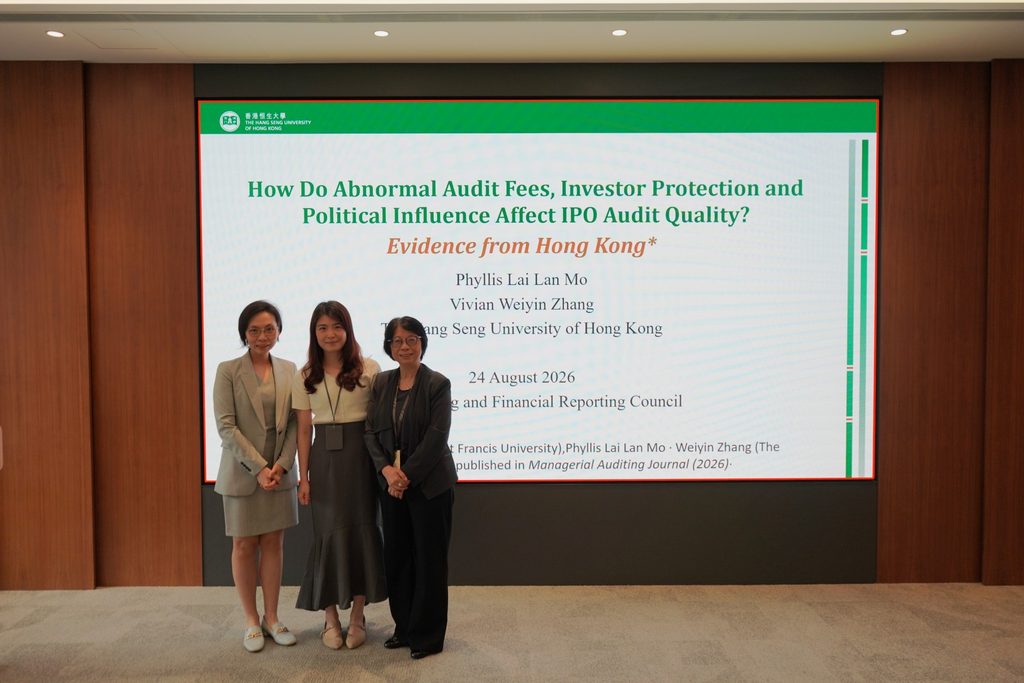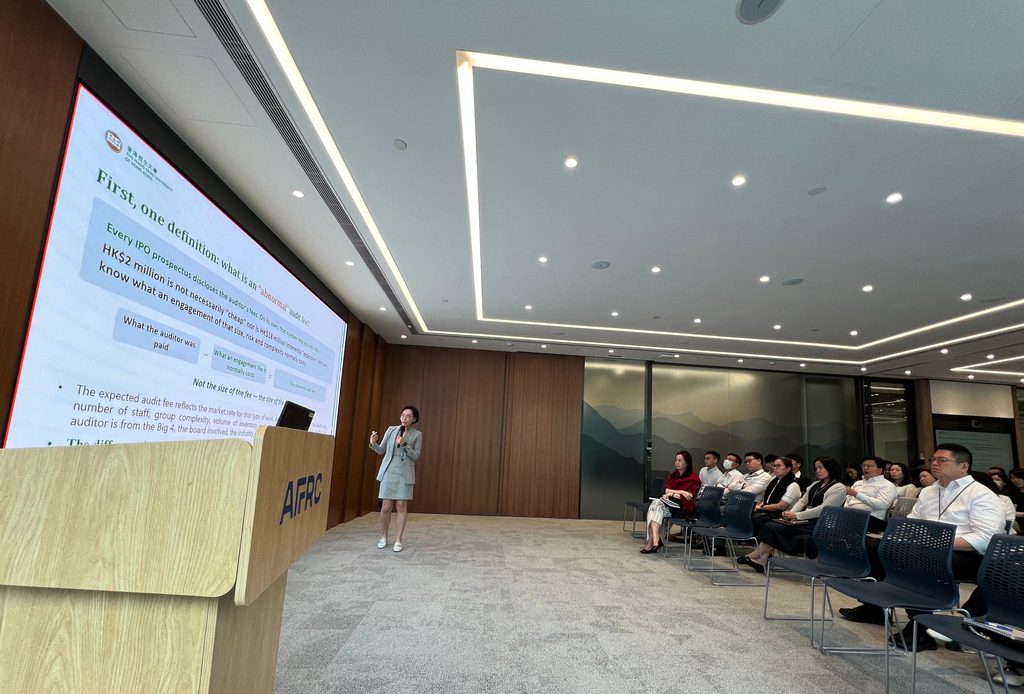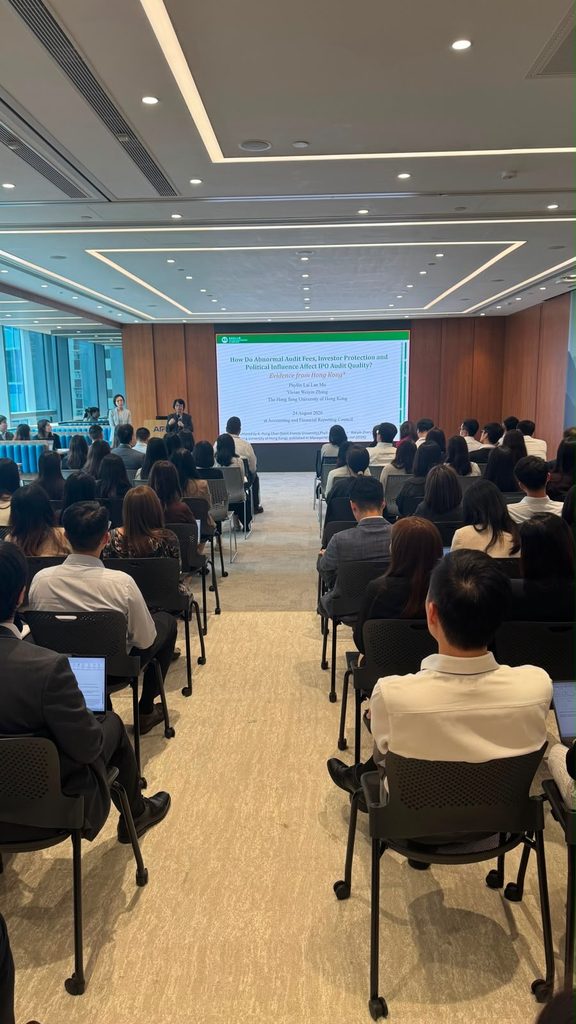
On 24 August, Professor Phyllis Mo and Dr Vivian Zhang from the Department of Accountancy were invited by the Accounting and Financial Reporting Council (AFRC), Hong Kong’s independent auditor regulator, to share their latest research on IPO audit quality. This collaboration brought cutting-edge academic evidence directly into the regulator’s critical discussions on enhancing audit quality.
Professor Mo and Dr. Zhang presented two influential studies co-authored with Professor K. Hung Chan. The first, published in Managerial Auditing Journal (2026), reveals that in Hong Kong’s strong investor protection environment, higher audit fees align with better audit quality, reflecting the extra effort auditors invest in complex IPOs. Conversely, their earlier study in the Journal of International Accounting Research (2021) found that in Mainland China’s weaker regulatory setting, higher fees did not guarantee improved audit quality. Together, these findings highlight how a robust regulatory framework is essential for audit fees to translate into genuine audit rigor.
The session sparked lively discussions among AFRC staff about factors shaping audit quality and underscored the value of academic research in complementing regulatory expertise. The AFRC emphasized two key takeaways: audit fees must fairly match the engagement’s complexity and risk, with abnormally low fees raising red flags; and strong investor protection combined with effective oversight is vital to uphold audit quality and market confidence. The AFRC expressed gratitude to HSUHK scholars and looks forward to deepening collaboration to support trustworthy financial reporting.
This engagement is especially timely as Hong Kong’s IPO market continues to break records. In the first eight months of 2026, 106 new listings raised HK$342.4 billion (about US$43.7 billion), up 153 per cent year on year and already surpassing the whole of 2025, with more than 400 companies still queuing for listing. HSUHK’s School of Business remains committed to turning rigorous research into practical insights that shape policy, strengthen regulation, and enhance market integrity.