
The Department of Economics and Finance at The Hang Seng University of Hong Kong held the second session of its Economics and Finance Public Lecture series on 22 October 2026 (Thursday). Dr. Albert Ngai spoke on “How Finance Fuels and Fails Real Estate”.
Dr. Albert Ngai is an accountant and corporate finance practitioner with over 30 years of experience. He held senior management and financial roles and took part in financing, mergers and acquisitions, and “white knight” restructuring and rescue transactions with a combined value of billions of Hong Kong dollars. In 2005, he led a team that helped a major Indian trading conglomerate secure HK$500 million in financing and complete the acquisition of a newly renovated hotel property. In 2023, he led the advisory work for one of Hong Kong’s largest subsidized housing management groups on an asset disposal valued at HK$170 million. In 2024, he served as the financial advisor for the pre-IPO financing round of a local technology unicorn.
The lecture was for students who want a career in investment banking, corporate finance, or financial advisory, and to see how ordinary finance fails when a liquidity crunch strikes a property market. Dr. Ngai opened with a recap of the rate channel that ties Hong Kong to the United States. Students worked through the arbitrage mechanism. When the effective federal funds rate rises, funds flow out of the Hong Kong dollar, the Hong Kong Monetary Authority buys Hong Kong dollars, the monetary base contracts, and the Hong Kong Interbank Offered Rate (HIBOR) rises. When the federal funds rate falls, funds flow back into the Hong Kong dollar, the monetary base expands, and HIBOR falls. HIBOR tracks the effective federal funds rate closely, and the Hong Kong dollar exchange rate holds. He also warned that the federal funds rate, the overnight uncollateralized interbank rate, is a common proxy for monetary policy in academic work, and that it is not the rate most often used to price derivatives or to value corporate cash flows.

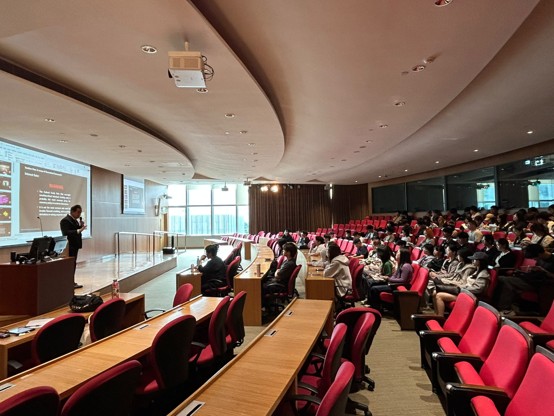
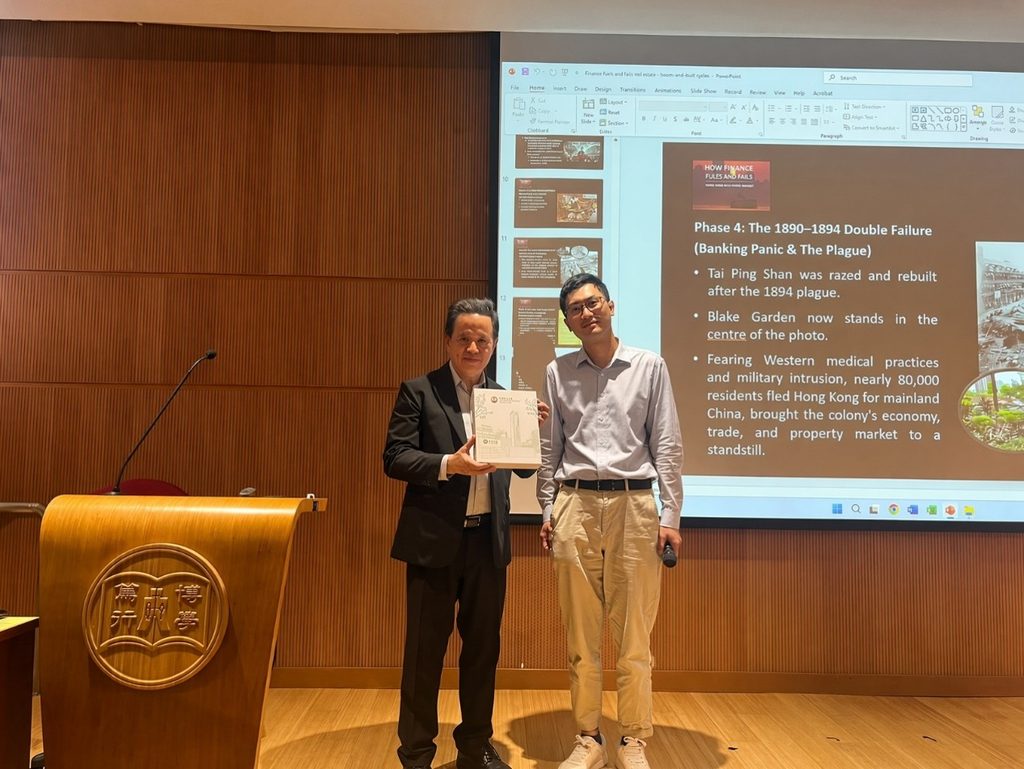
With that mechanism in place, the lecture turned to how finance fails real estate. Dr. Ngai took students through Hong Kong’s boom-and-bust cycles, including the double failure of 1890–1894, when a banking panic and the plague struck together. Tai Ping Shan was razed and rebuilt after the 1894 plague. Fearing Western medical practices and military intrusion, nearly 80,000 residents left Hong Kong for mainland China. Trade stopped, and the property market came to a standstill.
These are the questions the Minor in Real Estate Finance and Investment is built to answer. The minor is designed for students enrolled in the BBA (Honours) in Finance and Banking. It adds a professional stream to the degree: seven specialist modules covering urban and real estate economics; the legal, financial and regulatory framework; urban planning and land law; measurement, appraisal and performance; real estate finance and investment; development practice and financing; and real estate as a global asset. The pathway is accredited by the Royal Institution of Chartered Surveyors (RICS) in Valuation. Students also complete Professional Practice Challenges in the minor, so classroom ideas are tested on practice-oriented problems. Students on the accredited route can progress, after graduation, toward chartered status through relevant work experience and the RICS Assessment of Professional Competence.