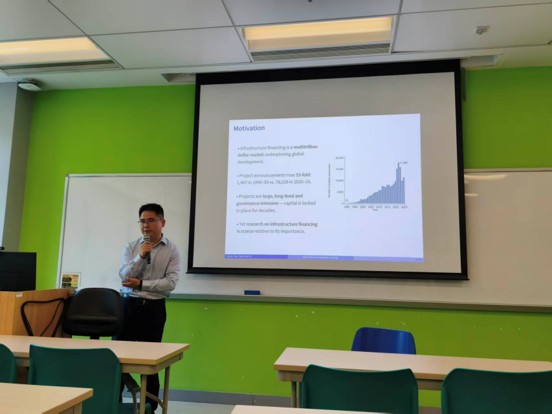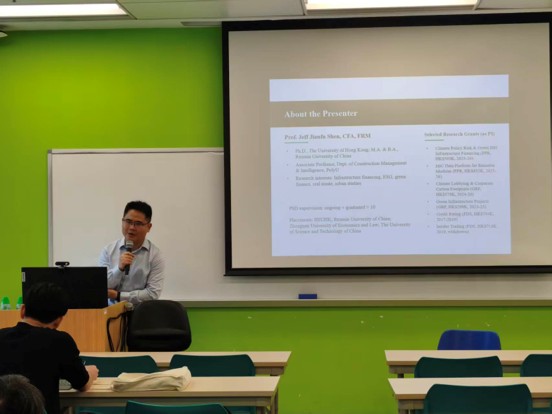
The Department of Economics and Finance at The Hang Seng University of Hong Kong held a research seminar on 22 October 2026. Professor Jeff Jianfu Shen, CFA, FRM, Associate Professor in the Department of Construction Management and Intelligence at The Hong Kong Polytechnic University, spoke on “Real Effects of Nonbank Lending: Global Evidence from Infrastructure Financing”. The paper is joint with Iftekhar Hasan (Fordham University, the Bank of Finland and the University of Sydney), Lulu Pan (Zhongnan University of Economics and Law) and Jing Yu (the University of Sydney).
The talk asked what changes when infrastructure credit moves from banks to nonbanks. Banks have long supplied both the money and the governance that goes with it: screening, covenants, monitoring and renegotiation. After Basel III, holding that kind of long, illiquid loan became more costly for banks, and more of the lending shifted to nonbanks. Drawing on loan and project-finance records linked to satellite data, the paper finds that nonbank participation raises loan spreads by about 81 percent and makes financial covenants less common. Projects also show more failure, distress and sponsor withdrawal, higher recorded costs, and more forest loss around the sites. Where a multilateral development finance institution joins the deal, part of that gap narrows.
Professor Shen closed on a direct point. A nonbank can supply the capital. The screening, the covenants and a lender who can renegotiate still depend on who sits in the syndicate. For students in finance and real estate, that membership shapes the price of risk, the control written into the contract, and what happens to the project and the land around it once construction starts.